

Results from glacier measurements in 2020
The Norwegian Glacier Museum & Ulltveit-Moe Center for Climate Science in Fjærland annually measures front changes on some local glaciers.
As part of a network with other glacier enthusiasts, we help NVE (Norwegian Water Resources and Energy Directorate) monitor several glaciers. Front changes are measured on 30 to 40 glaciers around the country.
The glaciers for which the Norwegian Glacier Museum is responsible are Vetle Supphellebreen in Fjærland and Haugabreen in Jølster. The front of Vetle Supphellebreen decreased by 6 meters compared to the previous year and has melted a total of 30 meters since 2011. At Haugabreen, the front retreated 8 meters, which means a melting of 84 meters since 2013.
Haugabreen glacier in 2015 and 2020. The images show how more mountains are emerging around the glacier, especially the area marked with red circles in each image. In addition, a small lake is emerging in front of the glacier.
In the fall of 2020, NVE reported that there was a positive mass balance on several glaciers. The term mass balance says something about how much snow the glacier receives each year, versus how much ice and snow melts away. This can be compared to an accounting system, where you have income and expenses. The year 2020 was therefore a good year for the glaciers' accounts. This means that a lot of snow fell during the accumulation season, which usually lasts from November to April. The temperatures during the melting season, which typically lasts from May to October, in 2020 were unable to sufficiently consume the snow and ice on many of the glaciers to create a deficit.
If we look at the changes in glaciers over time, the retreat of the fronts shows that there is not enough snow to cover the deficit. This is the long-term trend for Norwegian glaciers in the 21st century.
The development of the front position of five selected glacier arms from Jostedalsbreen in the period 1899 - 2020. Nigardsbreen in Jostedalen, for example, has retreated almost 3 kilometers in about 120 years.

Glaciers continue to retreat
The Norwegian Glacier Museum & Ulltveit-Moe Center for Climate Science in Fjærland annually measures front changes on some glaciers in the area.
The Haugabreen glacier in Jølster retreated 6 meters, while the Vetle Supphellebreen glacier decreased by 22 meters. The glacier tongues have also melted a lot along the sides and have become thinner overall in recent years. This can be clearly seen, for example, from images of the Haugabreen glacier in 2015 and 2019.
Haugabreen in 2015 on the left and in 2019 on the right.
It is a bit sad to continue to communicate about these glaciers that are retreating and decreasing in size year after year. The temperature during the melting season increases and the normally large amounts of snow in winter are not enough to compensate for the mass loss from the glaciers.
The glacial melt has consequences that are important to focus on. Glaciers provide us with a stable water supply for renewable power generation and for irrigation in agriculture, they are a tourist attraction, they are in themselves natural masterpieces that provide qualities for living in the countryside and they can give us a lot of information about past climates. In other places in the world, glaciers are important as water sources for both drinking water and agriculture, and with bad news for glaciers, this is bad news for the people who depend on them.
Perhaps many of nature's great wonders, most notably glaciers, will be drastically altered or even disappear within a few generations. We who can see and experience glaciers today are witnesses to changes that are large and, not least, rapid from a geological perspective. It is the speed of the changes that is so frightening, and it is global warming due to human-made emissions of greenhouse gases and large-scale land changes that are the drivers of these changes.
The Norwegian Glacier Museum previously also measured the Bøyabreen and Store Supphellebreen in Fjærland. These are now being photographed and there are clear changes that can be captured with a camera.
The Bøya glacier in 1997 and 2019.
It is clear that these two glaciers have been important icons for tourism for over 150 years in Fjærland. Tourists came from far and wide to see and experience the magical ice. The landscape itself with the fjord and mountains is fantastic and unparalleled, and with the glaciers it has a high international quality. But without the glaciers, an important natural element could be lost. This is something that affects us all, whether we are tourists or local residents. By that I mean that we all contribute to greenhouse gas emissions and land changes on the planet, through our lifestyle with a lot of travel and consumption. We who work at the Norwegian Glacier Museum and with this communication experience that many of our visitors are concerned with reducing emissions and living more sustainably. How many climate summits in the UN will it take to actually reverse the trend, and is this possible?

Glaciers shrink in 2018
The Norwegian Glacier Museum & Ulltveit-Moe Center for Climate Science are measuring the front position of two glaciers in Jostedalsbreen National Park. The measurements show that they are retreating in 2018.

The front of Vetle Supphellebreen on October 11, 2018.
Front position measurements
After advancing for the past three years, Vetle Supphellebreen was supposed to retreat in 2018. The result was -6 meters. Ever since the Norwegian Glacier Museum resumed measurements in 2011, the glacier has remained relatively stable in terms of front position. The glacier was also monitored in the period 1899-1944 and then retreated almost 450 meters.
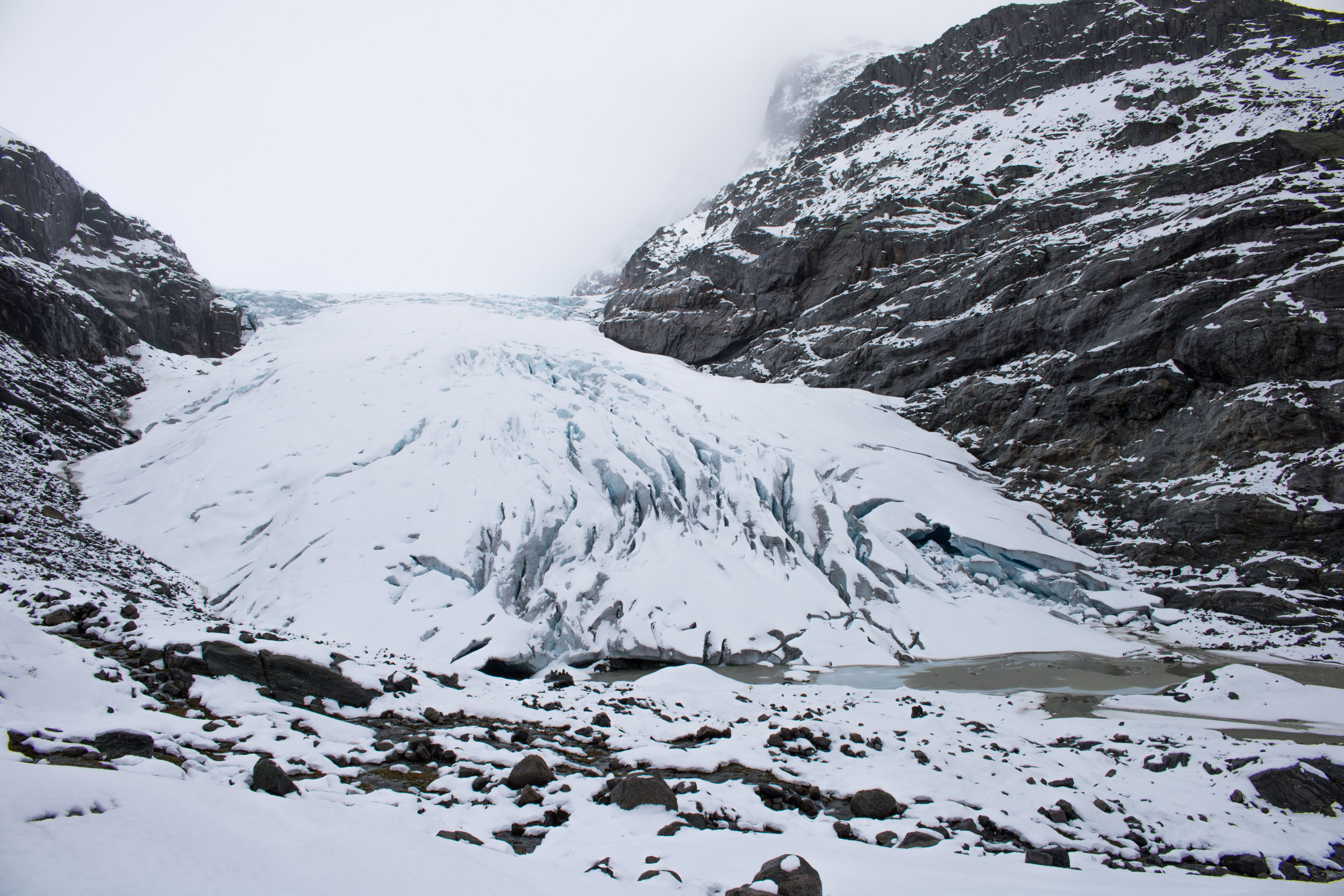
Haugabreen glacier in early October 2018.
The other glacier whose front position is measured is Haugabreen in Jølster. It decreased by 16 meters in 2018, and has retreated a total of 69 meters since we started measuring the glacier in 2013. In recent years, more and more water has appeared around the front of the glacier. In the long term, it may become difficult for those going on glacier hikes to get up onto the glacier dry-shod.

Bøyabreen on October 1, 2018.
In addition, the more well-known glacier arms, Bøyabreen and Store Supphellebreen, are also monitored by taking photographs every year. The melting of the glaciers makes front position measurements difficult, but photographing the glaciers allows us to document their development.
More information about front position measurements and other glacier measurements can be found on NVE's glacier data website . There you can read that glaciers in Norway shrank significantly in 2018, for example, Engabreen in Nordland retreated a full 140 meters and Nigardsbreen melted 81 meters.
Brear and climate
The hot summer took a toll on the snow and ice mass of Jostedalsbreen in 2018. The glaciers have been retreating for over 20 years since they advanced in the late 1990s. This is part of the long-term trend of glacier shrinkage in an increasingly warm climate. According to the World Meteorological Organization (WMO), 2018 is set to be among the warmest years ever recorded on the planet since temperature measurements began in the mid-19th century.
Breane is, among other things, our most important water reservoir. As much as 70% of all fresh water on earth is stored in the form of ice, and the glaciers thus provide a stable water supply for many people. In addition, the glaciers around the world are one of our best climate archives.

Report from the glacier measurements in 2017
Vetle Supphellebreen is bucking the trend and advancing in 2017, while Haugabreen is retreating.

At the front of Vetle Supphellebreen in early November 2017. Photo: Pål Gran Kielland.
For us glacier enthusiasts, it is always good news when a glacier grows and advances. Vetle Supphellebreen advanced for the third year in a row, by almost 2 meters in 2017. We started with front position measurements of the glacier in 2011 and the glacier showed retreat in the first few years. During the measurement period, the glacier has advanced a total of 4 meters, or in other words, remained stable. An excess of snow during the measurement period may explain the development of Vetle Supphellebreen. If we look at the Meteorological Institute's weather and climate data, the measuring station at the Norwegian Glacier Museum has registered precipitation amounts above normal in the period 2011-2017. Large amounts of snow may be part of the explanation for the glacier's advance in recent years. Together with factors such as temperature, latitude, altitude, terrain (steepness and solar radiation) and proximity to the sea (maritime), precipitation is part of a complex interaction that leads to the formation and change of glaciers. It is especially the relationship between winter precipitation and summer temperature that controls the glacier's balance from year to year.

Haugabreen glacier after fresh snowfall in November 2017. Photo: Pål Gran Kielland.
Haugabreen set a personal negative record when it retreated 18 meters in 2017. Since we started measurements on this glacier, it has decreased by a total of 53 meters. There is also an increase in precipitation here when we look at weather data from nearby measurement stations, but the precipitation has clearly not been enough to slow down the melting. In addition, it must be remembered that the glacier's reaction time to changes in climate is delayed. Since glaciers are mainly controlled by winter precipitation and summer temperature, changes in these climate parameters will be reflected by the glacier. Light snow and/or low temperatures cause the glaciers to grow, while little snow and/or high temperatures cause the glaciers to melt.
The front changes show how the length of the glacier changes from year to year, and are a picture of how the glacier volume changes over time. The changes that can be seen on a glacier front are a delayed reaction to changes in mass balance. The reaction time of the glaciers depends, among other things, on length, steepness and friction against the ground. Around Jostedalsbreen, the reaction time of the outlets varies largely between 3 and 30 years.
Otherwise, see the NVE website for more information about our glaciers.

Best season in 20 years
This season we have had 72,500 guests through the doors of the museum. This makes 2016 the best season in 20 years. In the last two years we have had a growth of 37 percent, which means more than 20,000 more guests.
Photos from the 25th anniversary celebration where HRH Crown Prince Haakon visited us.
Director John Brekke can inform you that we are increasing particularly significantly in the Asian market this year.
We thank everyone who has been with us, collaborated with us, and contributed to a great season in 2016!

Season opening with new design April 1st
This winter we have renewed the entire exhibition in the museum. Among other things, with a new interactive exhibition about global warming!
From April 1st you can experience the Norwegian Glacier Museum in a new look. Opening hours are 10:00 - 16:00.
We have already kicked off the season at Easter with visits from groups, events at Fjærland Sogelag and open to all on Easter Sunday.
The snow is still on the ground around the museum, which means that the educational playground is not yet fully ready for use. But with the renovated and upgraded main exhibition, with a new design and refreshed colors, as well as the film about Jostedalsbreen by Ivo Caprino and the fantastic climate exhibition, we are ready for an exciting and educational visit.
Welcome to the Norwegian Glacier Museum season 2016!
PS: this year we celebrate our 25th anniversary.

Merry Christmas & Happy New Year
Welcome back to the Norwegian Glacier Museum in Fjærland in 2016. We will reopen the museum on April 1st, with exciting upgrades to the museum!
And remember: in 2016 we have our 25th anniversary.
Director John Brekke