

The Norwegian Glacier Museum opens for the season!
We are pleased to announce that we are open for the season. The museum is open every day 10 am - 5 pm.
After a time of uncertainty this spring, we can now finally open our doors. Normally we are open from April 1st, but the situation with Covid-19/Coronavirus made it difficult.
Now we are finally back on track and can welcome guests as before.
WELCOME TO US :)
NB: we have developed internal guidelines for infection control and follow the advice of the Norwegian authorities. We encourage everyone to be considerate of each other, both towards other guests and staff, and to respect infection control measures. Remember to keep your distance, wash your hands, etc.
We can report that there are also lots of other things in Fjærland that are open, such as Bokbyen, guiding, hotel and camping. See the Facebook page of “Fjærland” or www.fjaerland.org for things to do.

Glaciers shrink in 2018
The Norwegian Glacier Museum & Ulltveit-Moe Center for Climate Science are measuring the front position of two glaciers in Jostedalsbreen National Park. The measurements show that they are retreating in 2018.

The front of Vetle Supphellebreen on October 11, 2018.
Front position measurements
After advancing for the past three years, Vetle Supphellebreen was supposed to retreat in 2018. The result was -6 meters. Ever since the Norwegian Glacier Museum resumed measurements in 2011, the glacier has remained relatively stable in terms of front position. The glacier was also monitored in the period 1899-1944 and then retreated almost 450 meters.
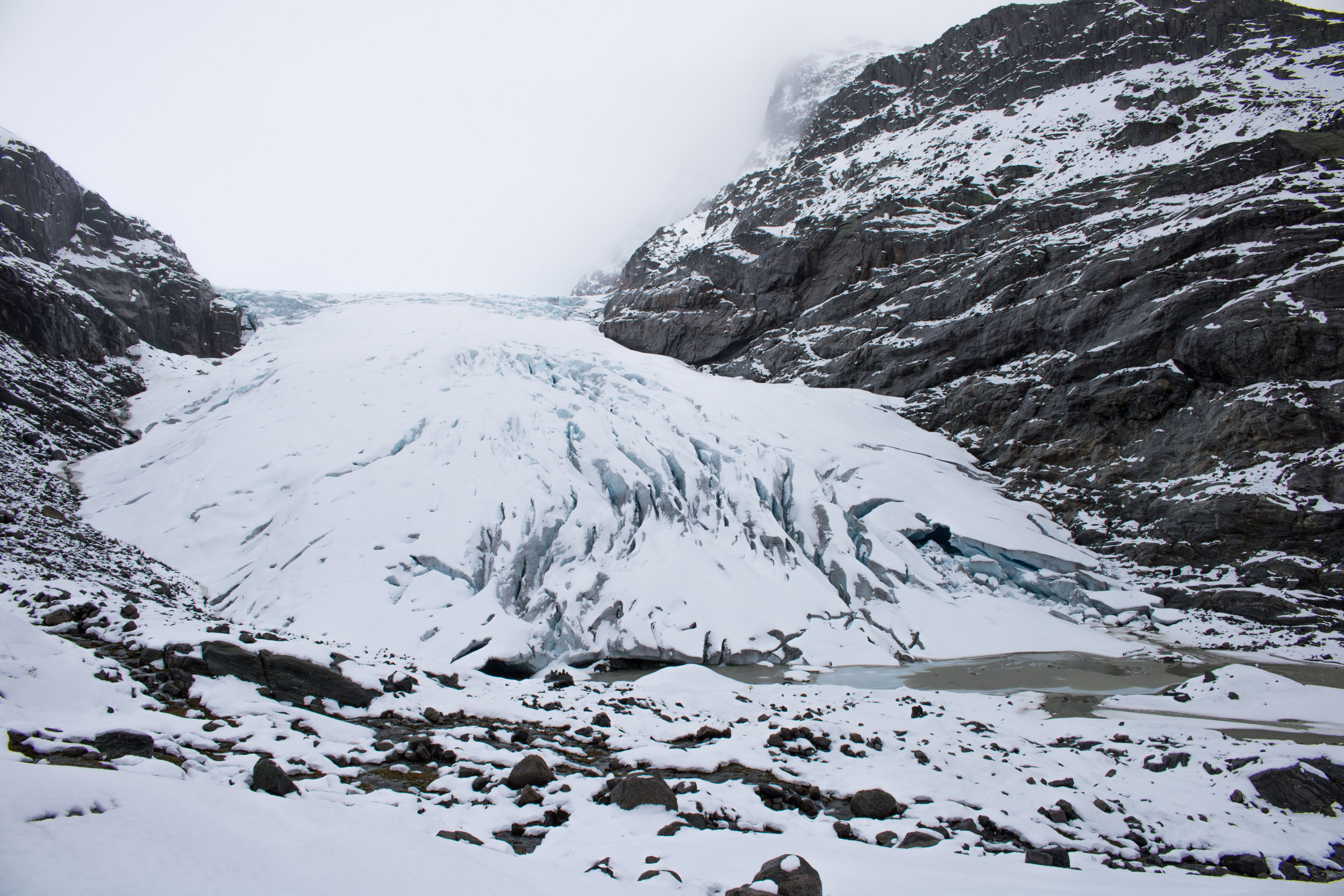
Haugabreen glacier in early October 2018.
The other glacier whose front position is measured is Haugabreen in Jølster. It decreased by 16 meters in 2018, and has retreated a total of 69 meters since we started measuring the glacier in 2013. In recent years, more and more water has appeared around the front of the glacier. In the long term, it may become difficult for those going on glacier hikes to get up onto the glacier dry-shod.

Bøyabreen on October 1, 2018.
In addition, the more well-known glacier arms, Bøyabreen and Store Supphellebreen, are also monitored by taking photographs every year. The melting of the glaciers makes front position measurements difficult, but photographing the glaciers allows us to document their development.
More information about front position measurements and other glacier measurements can be found on NVE's glacier data website . There you can read that glaciers in Norway shrank significantly in 2018, for example, Engabreen in Nordland retreated a full 140 meters and Nigardsbreen melted 81 meters.
Brear and climate
The hot summer took a toll on the snow and ice mass of Jostedalsbreen in 2018. The glaciers have been retreating for over 20 years since they advanced in the late 1990s. This is part of the long-term trend of glacier shrinkage in an increasingly warm climate. According to the World Meteorological Organization (WMO), 2018 is set to be among the warmest years ever recorded on the planet since temperature measurements began in the mid-19th century.
Breane is, among other things, our most important water reservoir. As much as 70% of all fresh water on earth is stored in the form of ice, and the glaciers thus provide a stable water supply for many people. In addition, the glaciers around the world are one of our best climate archives.

Report from the glacier measurements in 2017
Vetle Supphellebreen is bucking the trend and advancing in 2017, while Haugabreen is retreating.

At the front of Vetle Supphellebreen in early November 2017. Photo: Pål Gran Kielland.
For us glacier enthusiasts, it is always good news when a glacier grows and advances. Vetle Supphellebreen advanced for the third year in a row, by almost 2 meters in 2017. We started with front position measurements of the glacier in 2011 and the glacier showed retreat in the first few years. During the measurement period, the glacier has advanced a total of 4 meters, or in other words, remained stable. An excess of snow during the measurement period may explain the development of Vetle Supphellebreen. If we look at the Meteorological Institute's weather and climate data, the measuring station at the Norwegian Glacier Museum has registered precipitation amounts above normal in the period 2011-2017. Large amounts of snow may be part of the explanation for the glacier's advance in recent years. Together with factors such as temperature, latitude, altitude, terrain (steepness and solar radiation) and proximity to the sea (maritime), precipitation is part of a complex interaction that leads to the formation and change of glaciers. It is especially the relationship between winter precipitation and summer temperature that controls the glacier's balance from year to year.

Haugabreen glacier after fresh snowfall in November 2017. Photo: Pål Gran Kielland.
Haugabreen set a personal negative record when it retreated 18 meters in 2017. Since we started measurements on this glacier, it has decreased by a total of 53 meters. There is also an increase in precipitation here when we look at weather data from nearby measurement stations, but the precipitation has clearly not been enough to slow down the melting. In addition, it must be remembered that the glacier's reaction time to changes in climate is delayed. Since glaciers are mainly controlled by winter precipitation and summer temperature, changes in these climate parameters will be reflected by the glacier. Light snow and/or low temperatures cause the glaciers to grow, while little snow and/or high temperatures cause the glaciers to melt.
The front changes show how the length of the glacier changes from year to year, and are a picture of how the glacier volume changes over time. The changes that can be seen on a glacier front are a delayed reaction to changes in mass balance. The reaction time of the glaciers depends, among other things, on length, steepness and friction against the ground. Around Jostedalsbreen, the reaction time of the outlets varies largely between 3 and 30 years.
Otherwise, see the NVE website for more information about our glaciers.

Book City Mammoth in Fjærland
The weekend of August 26-27 is a mammoth sale in Bokbyen. There are many new books here, and most books are half price this weekend. Feel free to bring the kids - two great children's sections!

Photo: Gaute D. Bøyum.
Enjoy the view from the new square in Mundal, in the middle of Book City. Combine with a trip to the Norwegian Glacier Museum, Bøyabreen or a trip to one of the 12 trimposts in Fjærland. The book café and hotel cafés are open.
The shops are open 10am-4pm (Straumsvågs antiquariat 10am-6pm)
Please contact Bokbyen on tel. 57 69 22 10 or post@bokbyen.no
Follow Bokbyen at facebook.com/bokbyen.
Welcome to a wonderful weekend in Fjærland!

Electric car charging station
The Norwegian Glacier Museum & Ulltveit-Moe Center for Climate Science has recently established a charging station for electric cars in the parking lot.
The charging station was set up and operated by Grønn Kontakt, and supports all newer electric cars. There are 2 fast chargers (50kW DC) and 2 flexi chargers (22kW AC). The fast chargers make it possible to top up the battery of an electric car much faster than with a regular socket. In 15-30 minutes you have charged your battery and can continue driving electrically. For a full overview of Grønn Kontakt's charging network, you can download Grønn Kontakt's charging app or see www.gronnkontakt.no.
- Grønn Kontakt works to make it as easy as possible to drive an electric car, and we are very pleased to be able to offer charging at the Norwegian Glacier Museum & Ulltveit-Moe Center for Climate Science. The charging station complements our existing presence in Western Norway and we will build even more charging stations in the area in the future, says Ole Henrik Hannisdahl, CEO of Grønn Kontakt.

Norway's finest place for charging electric cars? (Photo: Pål Gran Kielland)
Director of the Glacier Museum, John Brekke, has the following to say about the charging station: - Being able to offer a charging station to our guests, the local population and others who drive through Fjærland fits perfectly with our profile as a glacier museum and climate center. We are grateful that Grøn Kontakt came to us and showed interest in establishing a charging station, and the collaboration has gone incredibly well! We provide knowledge about glaciers and climate to many people every year, and last year we were visited by 72,000 guests from different countries around the world. It is important for us to be able to show our guests the possibilities that lie in driving electrically, especially with a view to a green and sustainable future that allows us to take better care of the environment and the climate than we do today. After all, the Earth is the only home we have...

Best season in 20 years
This season we have had 72,500 guests through the doors of the museum. This makes 2016 the best season in 20 years. In the last two years we have had a growth of 37 percent, which means more than 20,000 more guests.
Photos from the 25th anniversary celebration where HRH Crown Prince Haakon visited us.
Director John Brekke can inform you that we are increasing particularly significantly in the Asian market this year.
We thank everyone who has been with us, collaborated with us, and contributed to a great season in 2016!

The blue ice is looking forward
The glacier hiking season starts a little later in Fjærland than on more popular and easily accessible glaciers around the world. Supphellebreen, or Flatbreen as it is also called, is now starting to become ready for those who want a glacier hike in a class of its own and well away from overcrowded tourist attractions.
Supphellebreen (Flatbreen) June 29, 2016. Photo: Pål Gran Kielland, Norwegian Glacier Museum.
Imagine getting up to this majestic glacier arm that juts out of the ice cap of Jostedalsbreen. It starts with a slightly demanding but at the same time fantastic hike on a good trail up from Rødseter in Supphelledalen at 50 meters above sea level, and up to the glacier front at about 1000 meters above sea level. On the glacier it is possible to get down into scary cracks in the ice, climb steep ice walls and step over breathtaking snow bridges. This may seem scary and challenging, but with local and experienced glacier guides this becomes a surefire experience. An exclusive extra offer is to cross this colossal mass of ice to climb one of the surrounding nunataks that tower up from the ice. From these peaks you can experience a fusion of glacier, mountains and fjords in a wild landscape that seems to be far away from civilization. But at the same time, you can look down into the Fjærlandsfjord and see how the glacial village of Fjærland is nestled right next to the calm Fjærlandsfjord.
Glaciers, mountains, fjords - and people! Photo: Gaute D. Bøyum August 2013.
How to get here, you may be wondering? And what about food and accommodation? The answer is simple. Down in Supphelledalen is Rødseter Inn , an old farm that has been partially converted into a guesthouse, hotel or as they call it themselves 'a small boutique hotel'. Here they offer activities on the mountains and glaciers according to your wishes, for example the kind of hike - glacier-mountain-fjord - to Myrhaugsnipa 1443 meters above sea level. An alternative for guided tours in Fjærland is also available from Mountaingoat Guiding .
In addition, you can take a leisurely walk in the village, kayak on the Fjærlandsfjord, have lunch at one of the hotels in Mundal, cycle, browse books in Bokbyen or make the obligatory visit to us - the Norwegian Glacier Museum.
Spectacular luxury - you will find it in Fjærland.

Book City celebrates 20 years
The Book City has a 20th anniversary in 2016 and it will be celebrated. They are putting a new twist on Book Night this year and moving the event to the new square in Mundal, right between Hotel Mundal and Fjærland Fjordstove Hotell. Much of the cultural program will take place inside the hotels, so you can warm up a bit during the evening. The market opens at 4 pm. The bookstores open at 10 am and stay open throughout the evening.
THE EVENING BEFORE BOOK NIGHT, FRIDAY JUNE 24
9:30 p.m.: Tove Bakke: Lorca. Pub evening with a Spanish atmosphere at Fjordstova.
BOOK NIGHT, SATURDAY, JUNE 25
1 p.m.: Celebration of the 20th anniversary of Bokbyen at Hotel Mundal. Canapes and sparkling water. Speeches and refreshments by Ragnar Hovland, Arne Ivar Kjerland and Laura Kvamme.
4 p.m.: Opening of Boknatta by Simone Stibbe. Booths open.
5 p.m.: Travel and relationships: Literary conversation with Hilde Kvalvaag and Brynjulf Jung Tjønn. Meet two authors who in the finest way depict us as closely as possible. With travel as a motif and relationships as a theme, they both write in a way that concerns the reader, about the longing to belong and be loved, about the fear of loss and loneliness. But always with hope as a driving force. Both have won the Brage Prize and they write for both children and adults. Both are inspired by music and invite the audience to listen to soundtracks from their writing along the way in the conversation led by Janne Karin Støylen. Hotel Mundal.
6 p.m.: Children's program at the square in Mundal: Do it yourself. Cooking in the open air with Ann Iren Ulvedal, Anne Britt Sårheim and Reidunn Otterdal using recipes from the book, Do it yourself.
7 p.m.: Ove Røsbak and Henning Sommerro. The two have collaborated since the early 80s. They have written several songs together and in 2004 the CD "Himmelhaik" was released, where Røsbak reads and sings and Sommerro is responsible for the music together with saxophonist John Pål Inderberg. Sommerro and Røsbak have a wild and unbridled style on stage, built on improvisation and a twinkle in the eye. The moods change with lightning speed, and can suddenly slide into both melancholy lyricism and lush beauty. Røsbak will read and sing things by Børli, Prøysen and himself in Bokbyen Fjærland, and Henning Sommerro will perform songs by Hyldbakk, Hoem and Røsbak that he himself has set to music.
Fjærland church.
8:30 p.m.: Johs. B. Thue: Narration from a new book, Gryta i fjorden – About home fishing and various fish dishes in our fjords. Fjærland Fjordstove Hotell.
10 p.m.: Concert: Billa and the Kid. Torget.
SQUARE ATMOSPHERE WITH FRIDTJOV URDAL, EIVIND ØDEGÅRD AND OTHERS DURING THE EVENING.
Food and drinks will be sold at the market square and Kaffistova. All events are open to everyone.
WELCOME TO THE BOOK MARKET AND FOLKLIFE!
To book a stall, call tel. 57692210 or post@bokbyen.no.

Crown Prince Haakon visits Sogn
On June 3rd this year, HRH Crown Prince Haakon will come to Fjærland to attend the celebration of the 25th anniversary of the Norwegian Glacier Museum.
The County Governor, in collaboration with the Palace, the Norwegian Glacier Museum and Sogndal Municipality, will prepare a special program for the visit, and will return with more information for the press and the public.

Season opening with new design April 1st
This winter we have renewed the entire exhibition in the museum. Among other things, with a new interactive exhibition about global warming!
From April 1st you can experience the Norwegian Glacier Museum in a new look. Opening hours are 10:00 - 16:00.
We have already kicked off the season at Easter with visits from groups, events at Fjærland Sogelag and open to all on Easter Sunday.
The snow is still on the ground around the museum, which means that the educational playground is not yet fully ready for use. But with the renovated and upgraded main exhibition, with a new design and refreshed colors, as well as the film about Jostedalsbreen by Ivo Caprino and the fantastic climate exhibition, we are ready for an exciting and educational visit.
Welcome to the Norwegian Glacier Museum season 2016!
PS: this year we celebrate our 25th anniversary.

Merry Christmas & Happy New Year
Welcome back to the Norwegian Glacier Museum in Fjærland in 2016. We will reopen the museum on April 1st, with exciting upgrades to the museum!
And remember: in 2016 we have our 25th anniversary.
Director John Brekke