

Plan for the preservation of River Sámi culture
The Ministry of Climate and Environment and the Sami Parliament are working to develop a plan for the preservation of River Sami culture.

Consultation input - River Sámi culture and salmon fishing
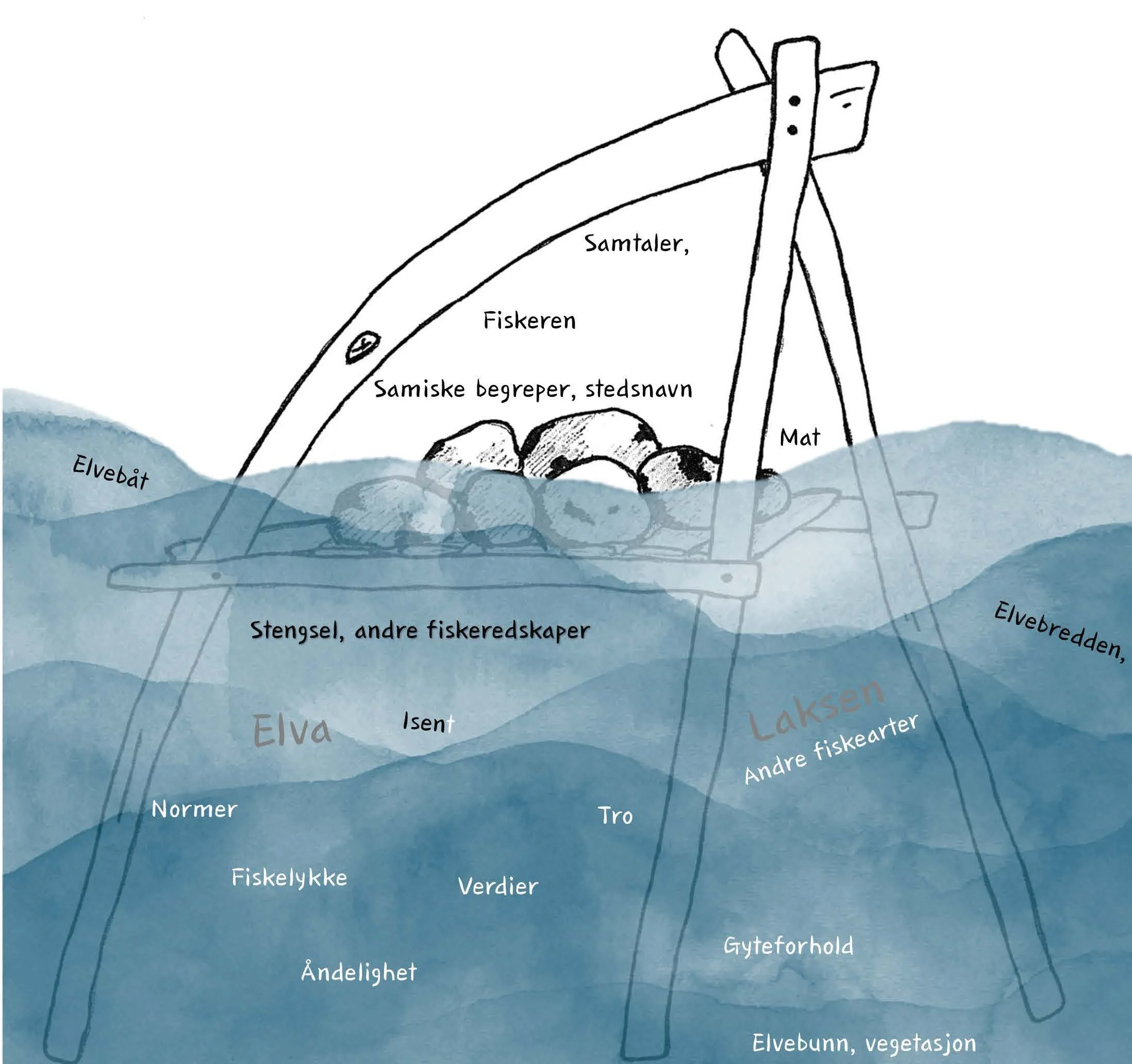
The contribution points out that River Sámi culture consists of many visible and invisible parts and can be preserved in various ways, but that fishing is a necessary material basis for the practice of culture. Through a separate "reŋko model" for the preservation of culture, the contribution shows how the practice of culture, such as the use of river boats, fishing for salmon ( bivdit ), setting up fences ( buođđut ), and roasting salmon on a fire by the riverbank, rests on traditional knowledge, values, norms and spiritual practices that are central to River Sámi culture.
A reŋko is a traditional river Sámi construction that is placed in a row in the river as part of the traditional fence ( buođđu ). Sámi salmon fishing culture is dependent on healthy salmon stocks, and rests on the existence of a harvestable surplus to fish. Parts of the culture can be preserved and transferred through fishing for other species or activities that do not involve fishing, but this will not necessarily preserve the connection between Sámi values and principles of the culture and the visible part of it such as the use of river boats and tools.
There are already far-reaching negative consequences of the ban on salmon fishing for the River Sámi economy, culture and health, where both food culture and meeting places are disappearing. It is of crucial importance to ensure the transfer of knowledge through practice to younger generations to ensure that River Sámi culture is preserved.
To the report
Sami salmon fishing culture depends on healthy salmon stocks
The input emphasizes that the River Sámi culture in the Tanadalen has a special status and indicates that recognition of a culturally based right to fishing and participation in management is important to strengthen self-determination and cultural practice. The project has had a special focus on the traditional knowledge about changes in the watercourse in light of climate change and the invasion of new species such as humpback salmon.
Natural conditions, River Sámi cultural practices and values are holistically integrated into each other, and are expressed through, among other things, food culture, sharing, skills, crafts, place names, yoik, stories and rituals. In this connection, the project has had its own yoik created as an illustration of the importance of the river in Sámi culture. In order for the River Sámi culture (reŋko) to stand firm, a holistic perspective on the management of the river and the communities on all sides of the river and the border between Norway and Finland is needed.
This includes that traditional knowledge is taken into account on an equal footing with scientific knowledge at an overall level, and is also included in the specific collection of knowledge. The consultation input summarizes preliminary experiences and reflections from the projects, with associated recommendations:
To the report
Recommendations …
Support initiatives for the inclusion of traditional knowledge in research and indigenous-led research such as the Council for Traditional Sami Indigenous Knowledge and River Sami Culture
Establish an indigenous area, cultural conservation area or biosphere reserve, and a separate Sami salmon center in connection with this in the Tanadalen Valley.
To support local organizations and knowledge carriers who document and maintain Sami knowledge and culture in the Tanadalen Valley
Support the education of young people and the transfer of knowledge to new generations